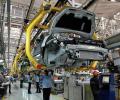
The K-shaped economic recovery in India from the pandemic slowdown shows in corporate results as well. The automobile sector, which represents big-ticket consumption, continues to do well and has increased its share in corporate revenues and profits while fast-moving consumer goods (FMCG) companies that sell low-ticket consumer goods are struggling with poor sales and earnings growth. The share of the automobile sector, including makers of auto ancillaries, in corporate net sales rose to a 10-quarter high of 10.05 per cent during July-September 2023 (Q2FY24) from 8.94 per cent a year earlier and 9.75 per cent in Q1FY24.

From the Sensex pack, Bharti Airtel, Asian Paints, Infosys, Bharat Electronics, Tech Mahindra and Eternal were major laggards. However, Maruti, Tata Steel, Bajaj Finance, Bajaj Finserv, Trent and Tata Consultancy Services were among the gainers.

Apollo Hospitals Enterprise (APH) delivered an in-line performance for the April-June quarter of the financial year 2024-2025 (Q1FY25)with growth in the number of patients. AHLL (Apollo Health & Lifestyle), a subsidiary, posted sales growth and profitability. APH also reduced operational costs at Healthco.

Equity markets this week will turn their focus on the RBI's interest rate decision, Q1 earnings from several blue-chip firms and tariff-related news for further cues, analysts said. Moreover, trading activity of foreign investors and trends in global equity markets will also drive investors' sentiment.

Reserve Bank of India (RBI)Governor Sanjay Malhotra on Friday said it was not the regulator's job to take decisions for bank boards, speaking in the context of the wide range of enabling reforms announced for lenders during the October monetary policy review, and emphasised that financial stability remained the regulator's focus.

Hindalco's India business, including Utkal Alumina, reported good results for the January-March quarter of the financial year 2024-25 (FY25) and consolidated earnings before interest, taxes, depreciation, and amortisation (Ebitda) also rose. Earnings growth was driven by favourable pricing, lower input costs and lower tax outgo for Novelis.

ICICI Bank delivered satisfactory results in the second quarter of 2025-26 (Q2FY26), sustaining return on assets (RoA) of around 2.3-2.4 per cent and improving asset quality. Provisions declined 26 per cent year-on-year (Y-o-Y) and 50 per cent quarter-on-quarter (Q-o-Q).

Reliance Industries may report a muted performance for the April-June quarter of FY24, with most brokerages expecting it to have witnessed a year-on-year (YoY) and quarter-on-quarter (QoQ) contraction in revenue and net profit during the period because of a poor showing by its oil-to-chemicals (O2C) division. The O2C division, which includes refining and petrochemical businesses, accounts for a little over half of RIL's revenue and profit. A muted showing by RIL in the first quarter of 2023-24 may weigh on the overall corporate earnings, as well as the equity markets.

The country's largest carmaker Maruti Suzuki India (MSI) on Wednesday reported a consolidated net profit of Rs 475 crore for the first quarter ended June 30. The auto major had posted a consolidated net loss of Rs 268 crore in the April-June quarter of 2020-21. It noted that during the first quarter its sales and production were adversely impacted due to the second wave of the COVID-19 pandemic.

While Paytm (One97 Communications) is not completely past regulatory hurdles, its share price has gained in the last month or two. The Paytm handle migration is complete along with FDI clearance necessary for the Payment Aggregator (PA) license. UPI consumer data indicates stable market share, and expansion in partner networks in financial distribution. All this implies Paytm could be set to meet guidance of turning Adjusted Ebitda breakeven by Q4FY25 (ex of UPI-incentives).

Thermax reported 13 per cent Y-o-Y revenue growth with operating profit margin decline in Q1FY25. It took a hit of Rs 70 crore on specific projects. The company enjoys a strong order pipeline across sectors like power, steel, refining and petrochemicals.

India's economic growth is expected to be lower at 6.3 per cent this fiscal compared to the RBI's projection of 6.5 per cent, a SBI Research Report said on Thursday. The report pegged the first quarter GDP estimate at around 6.8-7 per cent, mainly due to muted private capex.

The Centre's capital expenditure (capex) outlay for the April-June quarter (first quarter, or Q1) of 2022-23 (FY23) could be close to Rs 1.5 trillion, Business Standard has learnt. As a percentage of full-year capex Budget Estimates (BE) of Rs 7.5 trillion, this could be at similar levels to the trends in the past few fiscal years. It is in the July-September quarter (Q2) of FY23 that capex is expected to pick up, when a bulk of the long-term capex loans to states are expected to be expended.

Around 128.6 million people were employed in the unincorporated sector during July-September of FY26, showed the latest quarterly bulletin of unincorporated sector enterprises released by the National Statistics Office (NSO) on Tuesday. This is slightly higher than the 128.57 million in the previous quarter.

India's consumer price index (CPI)-based retail inflation rate is likely to have cooled further in June, thus remaining below the 4 per cent target of the Reserve Bank of India (RBI) for a fifth consecutive month, giving the central bank wiggle room to focus on growth. Economists reckon that the decline is on account of easing prices in various categories of goods, especially food items, and a favourable base effect.

This is despite the fact that total FDI into India has fallen by 22 per cent from $58 billion in FY22 to $46 billion in FY23, according to the Reserve Bank of India.

Banks reported muted treasury gains during April-June of FY25 (Q1FY25) following Reserve Bank of India's (RBI's) revised norms on investment portfolio effective from April 1, 2024, despite softening of government bond yields. "Banks have reported muted treasury gains during Q1 of FY25 despite softening of yields across the curve. "The main reason was change in the investment valuation and classification guidelines by the RBI.

TVS Motor Company met expectations in terms of revenue and posted a strong margin performance in Q1FY25. The key drivers were material cost savings and a better mix. The domestic demand outlook looks good with a rural rebound but geopolitical uncertainties in key export markets may dent overall growth.

IT major Wipro on Friday posted a 4.6 per cent year-on-year rise in its consolidated net profit for the June quarter at Rs 3,003.2 crore. The Q1 FY25 revenue of the Bengaluru-headquartered firm, however, fell 3.8 per cent to Rs 21,963.8 crore.
There have been several positive signals in Bharti Airtel with revenue market share (RMS) growth, better visibility of profits from Africa, and enough free cash flow to pursue deleveraging. Airtel's 4G and 5G data subscriber net additions were 5.6 million in Q1FY24, and 24.5 million in the last 12 months. Airtel currently has 230 million data subscribers on 4G/5G, which is about 70 per cent penetration of its base of 339 million subscribers.

GST 2.0 may cushion consumers against US tariffs, but like the 2019 corporate tax cut, it risks being another tactical fix rather than a structural growth strategy, expects Debashis Basu.

The recent blip in housing sales on a quarter-on-quarter (Q-o-Q) basis should not worry investors as the long-term prospects of real estate stocks remain on a strong foundation, according to analysts. In the first half of the calendar year 2024 (H1CY24), realty stocks surged up to 104 per cent. This sharp run should be used to book partial profit in related stocks, suggested Deepak Jasani, head of retail research at HDFC Securities.

Grasim Industries has reported a 24 per cent increase in net profit at Rs 130.49 crore (Rs 1.3 billion) for the quarter ended June 30, 2003 when compared with Rs 105.47 crore (Rs 1.05 billion) in Q1FY03.

India Inc, which is sitting on cash balances of 13.5 trillion, is using the funds to meet capital expenditure as well as brownfield expansion, resulting in 'anaemic' demand for bank loans, State Bank of India (SBI) chairman CS Setty said at an event on Monday. He added that a slowdown in corporate credit is mainly due to lack of demand.
The Reserve Bank of India (RBI) has sought granular data from select non-banking financial companies (NBFCs) on their loan book growth. The details sought are on the outstanding product-wise portfolio and the annualised interest charged on them. The annualised interest slabs mentioned are as follows: less than 10 per cent, 10-20 per cent, 20-30 per cent, 30-40 per cent, 40-50 per cent, and above 50 per cent.
Mphasis BFL has reported a 29 per cent dip in its net profit at Rs 9.02 crore (Rs 90.2 million) for the first quarter ended June 30, 2005 as compared to Rs 12.79 crore (Rs 127.9 million) in Q1 FY05.

The Reserve Bank on Wednesday revised upward its growth estimates for the current fiscal year to 6.8 per cent and lowered its inflation projection to 2.6 per cent based on an above-normal monsoon and the rationalisation of GST rates.

The changes in the domestic and global economy following the outbreak of the Covid-19 pandemic are altering the corporate profit league table in India. Reliance Industries (RIL), which topped the India Inc profit chart for more than a decade, lost out to State Bank of India (SBI) in the 2023-24 (FY24) April-June quarter (first quarter, or Q1). India's biggest lender reported a consolidated net profit (adjusted for exceptional gains and losses) of Rs 66,860 crore during the trailing 12-month (TTM) ended in June this year, ahead of RIL's TTM adjusted net profit of Rs 64,758 crore in the quarter.

SBI Life Insurance reported a weak performance in Q2FY25. The annual premium equivalent or APE grew 3 per cent year-on-year (Y-o-Y) to Rs 5,390 crore. For the first half of financial year 2025 (H1FY25), it grew 9 per cent Y-o-Y to Rs 9,030 crore.

The stock of Voltas, the country's largest room air- conditioner (RAC) maker, is up 22 per cent in the past three months. Robust demand on the back of a sweltering summer, distribution expansion, slew of launches and backward integration are expected to forge a good operating performance for the company. In the core RAC segment, there are multiple triggers for the company.

Once declared a dud stock, Suzlon has generated stellar returns for investors thus far this calendar year. On a year-to-date (YTD) basis, Suzlon's share price has doubled investor wealth by soaring 109.35 per cent on the bourses. By comparison, the benchmark BSE Sensex has gained just 11.2 per cent.

India's labour market in the second quarter (July-September/Q2) of 2025-26 (FY26) showed resilience, with the jobless rate easing even as more people entered the workforce. However, a rise in youth unemployment and a fall in the share of salaried workers remain areas of concern.

Voltas saw strong growth in both UCP (Unitary Cooling product) and EMPS (electro mechanical projects) segments.

Trent reported decent margins in the second quarter (July-September) of 2025-26 (Q2FY26) but growth moderated. Same store growth was low single-digits. Trent's revenue growth decelerated in Q2FY26 at 17 per cent year-on-year (Y-o-Y) while area additions were offset by decline in revenue per square foot (sq ft).

India's industrial production growth slowed to a nine-month low of 1.2 per cent in May 2025 due to poor performance of manufacturing, mining and power sectors caused by the early onset of monsoon, according to official data released on mMonday. The factory output, measured in terms of the Index of Industrial Production (IIP), had expanded by 6.3 per cent in May 2024.

'The essence of RMG is that users participate in skill-based games for financial reward, so this law would directly affect this operating model for both users and gaming companies.'
Cipla has posted a 11 per cent increase in net profit at Rs 67.20 crore (Rs 672 million) for the quarter ended June 30, 2003 as against Rs 60.63 crore (Rs 606.3 million) in Q1FY03.
Infosys has reported a 28 per cent increase in net at Rs 278.12 crore (Rs 2.78 billion) for the quarter ended June 30, 2003 when compared with Rs 216.85 crore (Rs 2.168 billion) in Q1FY03.

IT services firm Infosys on Thursday reported an 11 per cent rise in consolidated net profit in June quarter at Rs 5,945 crore, but lowered full year growth outlook to 1-3.5 per cent amid macro uncertainties. The net profit (before minority interest) during the same period previous year stood at Rs 5,362 crore.
At least 13 candidates are in the race for the position of managing director and chief executive officer (MD & CEO) of Punjab National Bank (PNB), the second-largest public sector bank (PSB), according to multiple sources familiar with the matter. "Among the candidates, some are executive directors (EDs) and managing directors in major PSBs. "Financial Services Institutions Bureau (FSIB) will conduct the interviews next month," said a source.
